
Picking a fabrication vendor isn't a box you tick and move on from. It shapes your product quality. Your delivery timelines. Honestly, it shapes how your own customers see you, months down the line. Get it wrong and you're stuck firefighting late shipments, tolerances that drift, finishes that peel within a season.
For OEMs sourcing sheet metal fabrication services, this isn't a simple price comparison. You're buying a partner, not a part. Someone who scales with you. Someone who catches a design flaw before it becomes a five-figure mistake. Someone who delivers the same quality on unit five hundred that they did on unit one.
At Fabtro, that's exactly the standard we hold ourselves to. So what actually separates a solid sheet metal fabrication company from one that'll leave you stranded mid-order? That's what this blog gets into.
Sheet metal doesn't forgive much. A tolerance drift of a few tenths of a millimeter, and suddenly an enclosure won't close, or a bracket sits crooked on the line. At scale, that's not one bad part. That's a whole batch, sitting there, useless.
A good partner absorbs risk instead of adding to it. That's really the whole point of vetting properly, before signing anything.
Plenty of vendors claim expertise. Fewer actually have the floor to back it up. Here's what separates the two.
Ask what's physically on the floor. Not what's printed in the brochure.
Has this partner actually built for OEMs before? Not a one-off retail display. Real production runs, with real specs and real accountability attached.
|
TRIVIA: “Sheet metal work goes back to the Bronze Age, when it was hand-hammered into shape. CNC bending would've seemed like sorcery back then.” |
This is where most vendors quietly fall short. Talking about quality control is easy. Actually catching a defect before it ships? Rare enough that you should ask for proof.
|
DID YOU KNOW? “One millimeter of dimensional inaccuracy on an enclosure panel is sometimes all it takes to fail an entire batch at fit-check.” |
Can they take a rough sketch all the way to full sheet metal production, without you switching vendors halfway? That matters more than it sounds like it should.
Whatever volume you're ordering now won't be your volume a year from now. Can the partner actually keep pace, or will they buckle?
Material choice and finish quality decide how long the part survives once it leaves the factory.
|
FACT: “Powder coating generally resists chipping and corrosion far longer than a traditional liquid paint finish does.” |
This is where design for manufacturability earns its keep. A partner who flags a manufacturability issue upfront saves you money you didn't even know was at risk.
Fast isn't the goal if it's unreliable. Predictable beats fast, almost every time.
Don't just nod along to a sales pitch. Ask what actually makes a vendor squirm a little.
Some warning signs whisper. Others just shout.
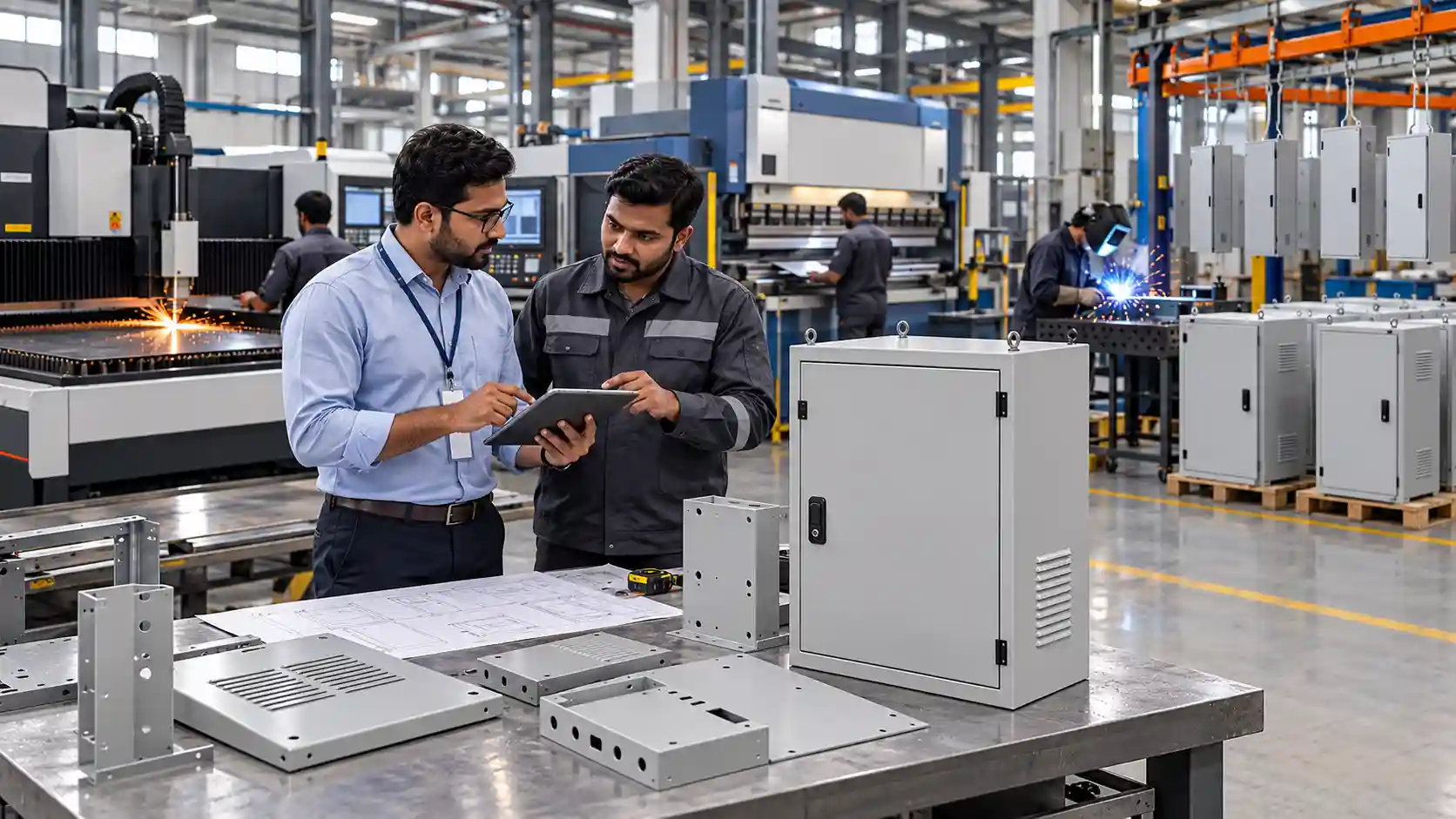
One roof changes everything. When CNC laser cutting, CNC bending, welding, and powder coating all happen inside a single facility, quality control doesn't get passed hand to hand between vendors. It just stays consistent, start to finish, raw sheet to finished part. Fewer handoffs, fewer chances for something to slip quietly. And when a fix is needed? One team owns it. Not three shops pointing fingers at each other. This is how Fabtro approaches every OEM project that comes through the door.
Gut feeling isn't a great evaluation method, not for a decision this size. A structured comparison works better — one built around what OEM production actually needs.
| Evaluation Area | What a Strong Partner Looks Like | Why It Matters for OEMs |
|---|---|---|
| Process Ownership | Cutting, forming, finishing, and assembly under one roof | Fewer handoffs, steadier quality control |
| Documentation | Detailed inspection records, traceable batch data | Faster root-cause fixes when something's off |
| Engineering Input | Reviews drawings early, flags design issues before tooling | Prevents expensive rework later |
| Scalability | Multiple lines, flexible shift capacity, a real scaling plan | Keeps pace as your volumes grow or shrink |
| Communication | Proactive updates, upfront about delays | Fewer surprises, easier planning on your end |
| Track Record | Verifiable OEM history in relevant industries | Lower risk handing over critical production |
A specification sheet only tells half the story, though. Visit the facility if you can swing it. Watch how a team handles a rushed sample order — that says more than any brochure ever will.
Choosing a sheet metal fabrication company for OEM production isn't a checkbox exercise. It's a long-term call that touches your product quality, your costs, and how much your customers trust you, order after order. Take the time. Ask the awkward questions. Lean toward partners who own the whole process in-house, instead of farming it out piece by piece.
Ready to build with a partner who gets OEM production right the first time? Reach out to Fabtro to discuss your project requirements today. |
It's how precision parts get made — enclosures, brackets, panels, housings — all built to exact OEM specs. Sheet metal fabrication services stretch from prototype sheet metal fabrication right through full-scale sheet metal production, so parts stay consistent, batch after batch.
Just ask, directly, about their manufacturing capacity and current utilization. A real partner gives you a number, not a vague reassurance. If they can't explain how they'd scale for you, that's your answer right there.
Due to flagging an issue on paper costs almost nothing. Flagging it after tooling's already built? That costs real money, real time. A good partner reviews drawings early, before mistakes turn expensive.
It does, more than people expect. In-house powder coating means tighter control over finish and turnaround. Outsourced coating adds a handoff, extra shipping, one more spot where quality quietly slips.
Ask how they inspect — raw material checks, in-process measurements, final verification. Dimensional accuracy shouldn't be assumed. It should show up documented, batch after batch, every time.