
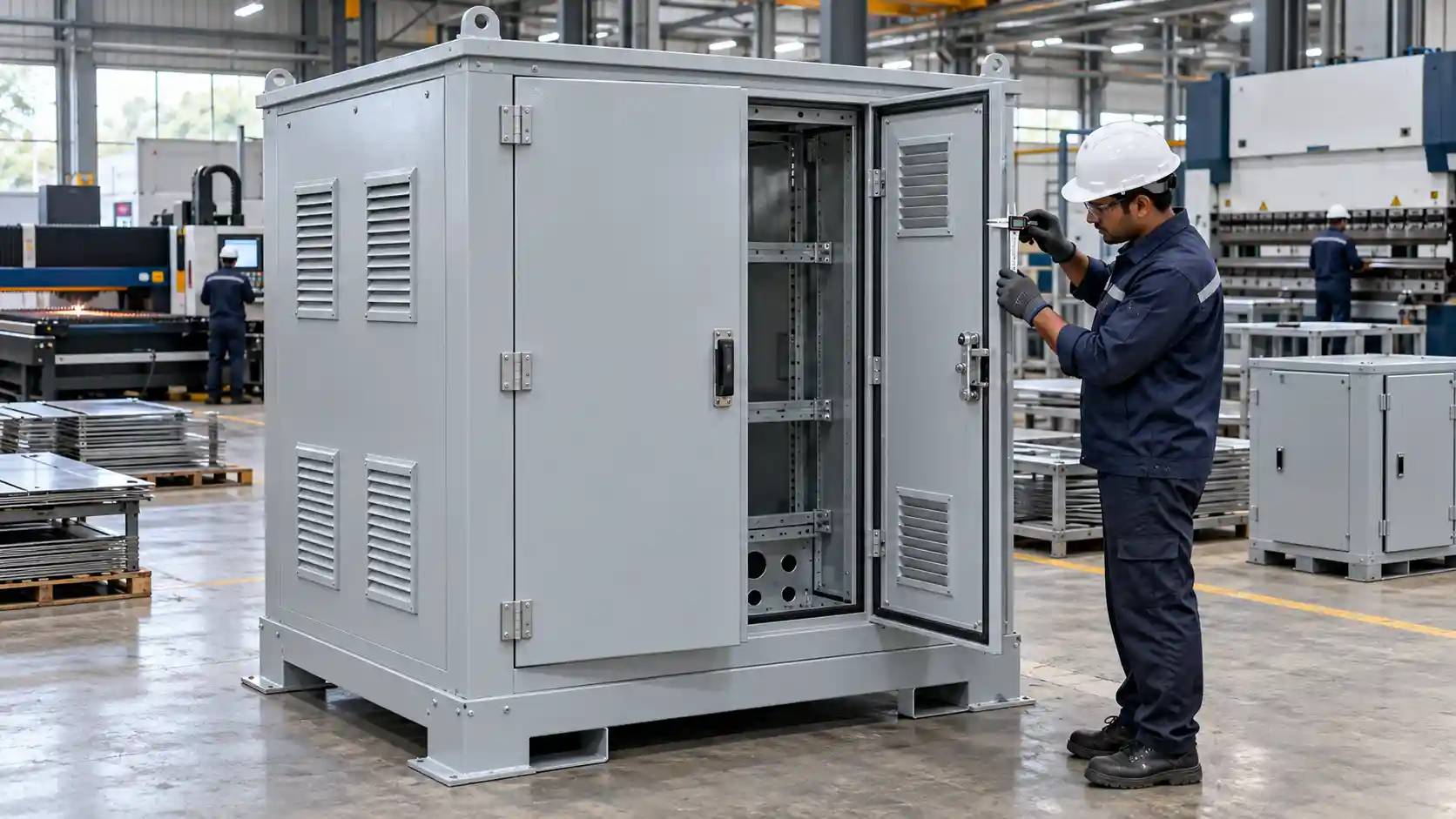
Most people who buy a transformer spend weeks comparing ratings and prices, then give the transformer enclosure about five minutes of thought. It’s easy to overlook, since the box just sits there. But it’s the part that stays out in the sun and rain for years, and when it’s badly made you usually only find out once a hinge has dropped or moisture has crept in near the terminals. If you’re sorting through transformer enclosure manufacturers and suppliers, a little planning up front saves a lot of grief later, so here’s what we’d check first.
Think about what an industrial transformer enclosure goes through in a normal year, with scorching afternoons in May, heavy rain in July and fine dust settling on everything through winter. Metal expands and shrinks along the way, and the thin sheet tends to bow after a while. If the vents are in the wrong place, heat stays around the windings and the transformer ages quicker than it ought to. A well-built electrical equipment enclosure handles all of that without drama, letting technicians open it easily while keeping live parts out of reach. It costs only a small part of the transformer’s price, yet it has a big say in how long that transformer keeps running.
Find out which jobs a factory does in its own shed and which it hands to outside vendors. Anyone making a custom transformer enclosure should handle most of these themselves:
When sheet metal fabrication happens in-house, one team owns the whole job, so a late batch can’t be blamed on some other vendor, and quality tends to stay more even from one order to the next. If you can, visit the plant and look at how tidy the floor is and how well the machines are kept. If you can’t, a short video of the shop floor does the same job better than any brochure.
Tolerances don’t sound exciting until a door refuses to close on site. Good precision sheet metal fabrication means mounting holes line up with your plan and panels sit flush against each other. A CNC fabricated enclosure also repeats well, so the fortieth unit matches the first, which matters a lot if you’re buying in batches. Ask what tolerance the shop holds and how it measures that.
No single metal is right everywhere. It depends on where the unit stands and what’s in the air around it. Here’s how the usual choices line up:
For general industrial use, a steel transformer enclosure does the job well. Near the sea, a stainless steel transformer enclosure costs more at the start but can outlast coated steel by years. It’s worth checking sheet thickness too, since thin metal flexes and cracks around the welds, and asking for mill test certificates so the grade on paper is what actually shows up.
Rain is the obvious threat, though dust and slow condensation do just as much harm and tend to get noticed much later. An outdoor transformer enclosure has to cope with both, along with hard sun and big temperature swings, so it helps to tell the manufacturer what you need before they quote. IP54 covers dust and splashes, while IP65 handles water jets. A genuine IP rated transformer enclosure relies on decent gaskets, sealed seams, a sloped roof and sensible vent placement, and where the rating really matters it’s fair to ask for test proof, since a figure on a datasheet doesn’t show much.
Stock sizes rarely fit every site. Good industrial enclosure customization means the maker adapts the design to your layout rather than the other way round. Check whether they can do these:
If you have your own drawings, bring them. The better transformer enclosure manufacturers will work from them and often catch small problems early, like a vent in an awkward spot or a door that’s a bit too narrow.
Before anything gets cut, you should see a drawing. A solid custom enclosure design process includes technical drawings for your approval and sometimes a prototype, which you can use to check door swing, cable routing and clearances against your transformer layout. Changes cost very little on paper, but once transformer enclosure fabrication is underway they get expensive quickly, so it’s worth insisting on sign-off.
A quality transformer enclosure doesn’t happen by luck, since it comes from checks at each stage and not just a glance before the truck leaves. Ask what actually gets inspected:
It’s also worth asking which enclosure manufacturing standards the shop follows and whether inspection records exist. A factory that writes things down usually works more carefully, and the records help if a problem turns up after delivery.
One good sample doesn’t prove much. What counts is whether the factory can repeat it at volume, so OEMs and bulk buyers should ask about monthly output, machine count and how repeat orders are handled, because the second batch ought to match the first. Lead time matters just as much. A dependable industrial enclosure supplier quotes realistic dates, warns you early if something slips and has a record of shipping on time. Asking for buyer references helps, and so does asking how urgent orders are treated. Among transformer enclosure suppliers, the reliable ones rarely overpromise.
Keep these handy when you call shortlisted transformer enclosure manufacturers. Quick, clear answers usually point to a partner worth trusting, while slow ones tell their own story:
If transformer enclosure suppliers dodge these, move on, and write the answers down so you can compare them later.
So why Fabtro? Fair question. Here’s what you can expect from us, from the first drawing right through to dispatch:
We’d rather be straightforward than make big promises. You tell us what you need, and we build it and deliver it when we said we would. Send your drawing or specification to Fabtro, and our team will help you settle on the right material, protection level and design.
Of course, price is a factor that should be considered, but not necessarily the only one. Consider the strength of the manufacturing, materials used, protection rating, ability to customize, and track record in delivery, and then compare prices. A good quality transformer enclosure will provide security for many years to come, whereas a poor quality one will usually end up in maintenance costs and losses in terms of downtime. Have a drawing or specification ready? Share it with Fabtro and we’ll help you take it forward.
Mild steel works for indoor and sheltered spots, galvanized steel copes better with rain and damp, and stainless steel is the pick near coasts or chemical plants. Let your site, budget and protection needs decide, and ask the maker to recommend one.
Look for in-house fabrication, drawing support and sample work, and share your transformer dimensions, cable entry and ventilation needs up front. Ask about lead time, inspection and coating too. If the maker asks sensible questions back, that usually signals real experience.
Check production capacity, inspection records, material certificates and delivery history, then confirm the IP rating, packaging and after-sales support. Compare quotes on value and not just price, since a cheap enclosure often turns costly later. Past buyer references help as well.
The IP rating tells you how well an enclosure keeps out dust and water. Outdoor units deal with rain, humidity and wind-blown grit, so a higher rating protects better, though the right level depends on your site and how exposed the unit is.
Yes, most manufacturers can build to your drawings or specifications, and things like dimensions, doors, locks, louvers, gland plates and mounting can all be adjusted. Share the transformer details early and get drawings approved before fabrication starts, which avoids costly changes later.
It depends on size, material, customization and quantity. Standard designs ship faster, while custom builds need drawing approval and extra fabrication time. Ask for a written delivery schedule, and check the supplier’s current workload before you order.