
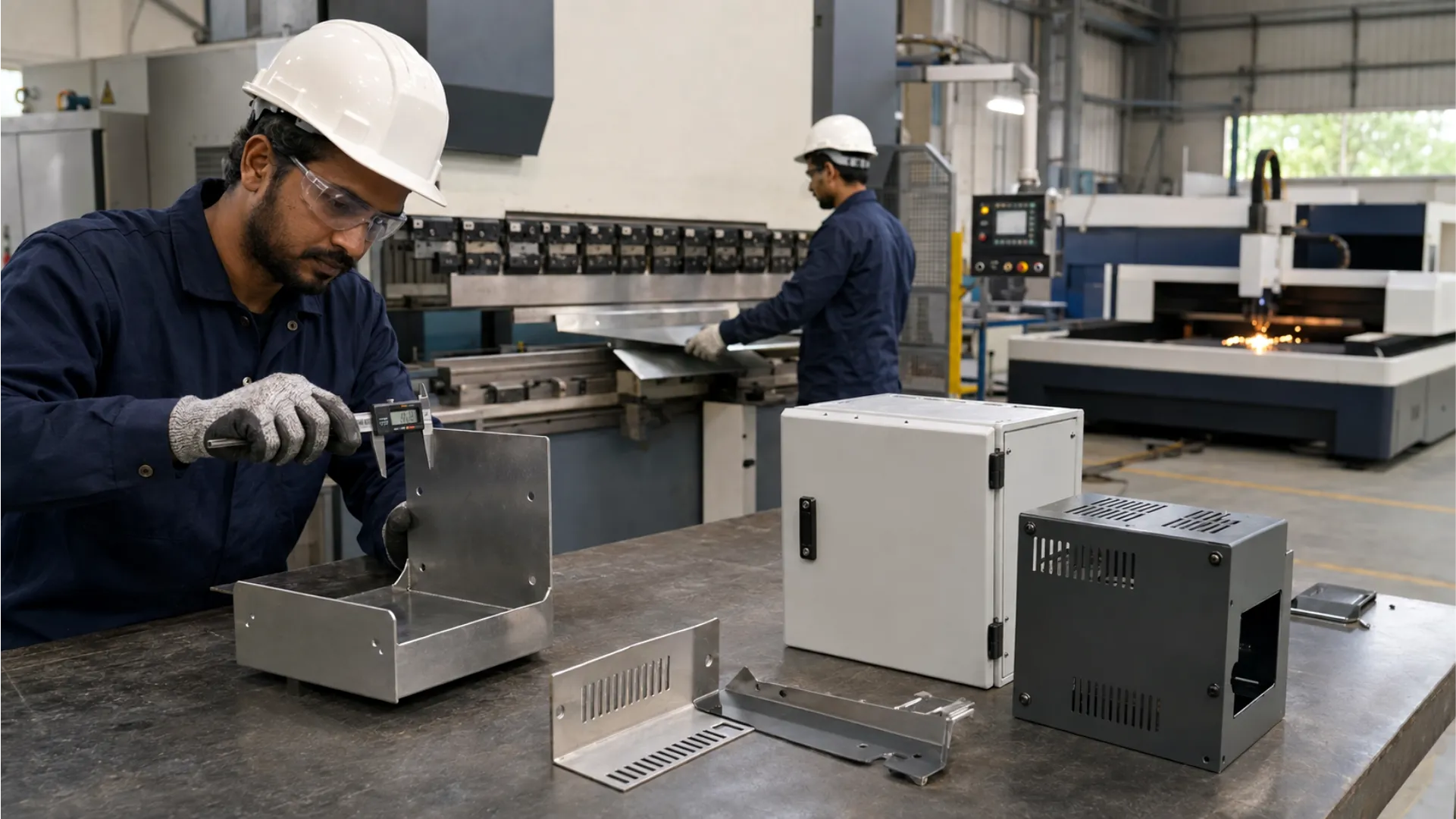
Fabtro is a trusted Manufacturer,Supplier and wholesaler of Sheet metal fabrication, which is a cornerstone of modern manufacturing, used across architectural structures, electrical enclosures, retail fixtures, and industrial machinery. Its ability to transform flat metal plates into durable, high-precision products has made it indispensable across a wide range of industries.
As businesses increasingly demand custom, cost-efficient, and high-quality metal products, choosing a manufacturing partner with advanced technology and strong engineering expertise becomes essential. Whether you need a single prototype or full-scale production, understanding the sheet metal fabrication process can help you make better decisions and achieve stronger project outcomes.
This guide covers what sheet metal fabrication is, how it works, the benefits it offers, the industries it serves, and the key factors to consider when selecting the right fabrication partner.
Sheet metal fabrication refers to the range of processes used to shape flat metal into a finished part, component, or product. These processes include cutting, bending, welding, machining, and surface finishing.
Compared to traditional manufacturing methods, fabrication offers far greater flexibility, allowing manufacturers to create custom designs suited to specific engineering requirements. Modern fabrication facilities rely on advanced CNC machinery and automation systems to deliver high production efficiency, consistency, and accuracy.
Commonly Used Metals in Sheet Metal Fabrication
Fabricated parts can range from simple components like brackets and enclosures to complex industrial assemblies and structures, depending on the application.
Every successful fabrication project follows a structured process designed to ensure precision, consistency, and quality.
The process begins with engineering drawings and CAD (Computer-Aided Design) modeling. Engineers assess manufacturing feasibility while minimizing waste and production costs. Key considerations at this stage include material thickness, tolerances, hole placement, bend radius, and assembly requirements.
Choosing the right material is critical to a product's performance and durability.
Material selection depends on the following:
For example, stainless steel is typically chosen for corrosion resistance, while aluminum is preferred where lightweight construction is a priority.
Laser cutting is one of the most precise fabrication methods available today. High-level CNC laser cutting machines can cut complex designs with excellent accuracy and minimal material waste.
Benefits include:
Laser cutting is widely used in the manufacture of machine parts, electrical panels, decorative panels, automotive components, and industrial machinery.
Once cutting is complete, metal sheets are precisely bent using a CNC press brake. Computer-controlled bending ensures consistent quality, with angles and dimensions that closely match the original design.
Common bending operations include:
Accurate bending is essential for manufacturing cabinets, enclosures, brackets, racks, retail displays, and structural parts.
Once individual parts are ready, skilled welders assemble them using a variety of welding techniques, including:
Additional assembly steps such as riveting, fastening, threading, or mechanical joining are used to complete the finished product.
Surface finishing enhances both the appearance and protection of fabricated metal products.
Popular finishing methods include:
These treatments improve corrosion resistance, wear resistance, and the overall appearance of the finished product.
Quality inspection is the final and one of the most critical steps in the fabrication process. Manufacturers thoroughly inspect:
A strict quality control process ensures that every part meets customer requirements before it leaves the facility.
Modern fabrication relies on a combination of manufacturing processes to produce complex, long-lasting products.
|
Process |
Purpose |
|
Laser Cutting |
Delivers detailed designs, precise cuts and supports high-volume production. |
|
CNC Punching |
Punches holes, slots and repeat pattern shapes quickly and efficiently. |
|
CNC Bending |
Creates accurate angles and dimensionally consistent shapes. |
|
Welding |
Joins fabricated parts together to form durable structures. |
|
Machining |
Adds holes, threads, grooves, and finishing details with precision. |
|
Powder Coating |
Provides a long-lasting, stylish, and corrosion-resistant finish. |
Material selection varies by project, depending on performance needs, environment, and budget.
|
Material |
Key Advantages |
Common Applications |
|
Mild Steel |
Strong, economical |
Structural fabrication, industrial equipment |
|
Stainless Steel |
Corrosion-resistant |
Food processing, medical equipment, enclosures |
|
Aluminum |
Lightweight, corrosion-resistant |
Aerospace, electrical panels, automotive |
|
Galvanized Steel |
Rust protection |
HVAC ducting, roofing, cabinets |
|
Copper |
Excellent conductivity |
Electrical components |
|
Brass |
Attractive finish, corrosion-resistant |
Precision parts and decorative fittings |
Sheet metal fabrication is widely preferred by businesses for its precision, durability, and cost-effectiveness, making it a valuable manufacturing method for both custom prototypes and large-scale production runs.
Advanced CNC laser cutting and bending machines ensure a high degree of precision and accuracy in every component, minimizing errors and simplifying assembly.
From custom enclosures and complex structural frames to machine guards and retail fixtures, sheet metal fabrication can accommodate a wide range of geometries tailored to specific project requirements.
Automated fabrication methods reduce material waste, labor costs, and production time, making the process cost-effective for both small and large production runs.
Fabricated metal products are engineered to withstand heavy loads, wear, and corrosion. Choosing the right material and surface treatment further extends product lifespan.
Advanced CNC technology, automated workflows, and streamlined production techniques allow manufacturers to deliver projects on time without compromising quality.
Sheet metal fabrication scales efficiently from prototypes to medium and mass production, adapting easily as demand grows.
Sheet metal fabrication serves a wide range of industries thanks to its versatility.
The fabrication partner you choose can significantly influence your product quality, project timeline, and overall cost. Here are the key factors to keep in mind:
Industry Experience
Look for a fabricator with proven experience across multiple industries and project types. Established companies are typically better equipped to handle complex designs and offer reliable solutions.
Advanced Manufacturing Technology
Choose a partner equipped with modern CNC laser cutting machines, CNC press brakes, welding equipment, and powder coating systems to ensure precision and efficiency.
Customisation Capabilities
Every project is unique. A strong manufacturing partner should be able to design and deliver tailored solutions that match your exact specifications.
Quality Assurance
Review the manufacturer's quality control practices, including material inspections, dimensional checks, and finishing processes, to ensure consistent output.
Production Capacity
Confirm the manufacturer can handle prototype development, medium-volume runs, and bulk manufacturing without missing delivery deadlines.
End-to-End Solutions
A single provider that manages design, fabrication, welding, finishing, and delivery simplifies project management and reduces lead times.
Customer Support
Clear communication and responsive technical support are essential for a successful, long-term manufacturing partnership.
At Fabtro Technologies, we combine cutting-edge manufacturing technology with strong engineering expertise to deliver precision sheet metal fabrication solutions across a wide range of industries.
Our goal is to manufacture products that meet the highest standards of quality, reliability, and custom design. We offer a complete manufacturing solution, covering concept development, design, fabrication, finishing, and delivery.
Our Capabilities
Our team of skilled professionals ensures that every prototype is built accurately, production remains consistent, and every order is delivered on time—whether the project is small-scale or large.
Fabtro Technologies offers an all-in-one fabrication and manufacturing solution, including:
Every product is manufactured using top-tier materials, state-of-the-art equipment, and rigorous quality control measures to ensure lasting performance and durability.
Sheet metal fabrication remains one of the most critical processes behind industrial, commercial, and infrastructure projects worldwide. Its precision, versatility, strength and cost-effectiveness make it essential to modern manufacturing.
Understanding the fabrication process and the importance of material selection helps ensure the reliability and quality of the finished product. Whether you need a bespoke metal enclosure, a custom structural component, or retail fixtures, choosing the right manufacturing partner is key to your project's success.
Looking for a reliable partner capable of delivering precision sheet metal parts and solutions?
Fabtro Technologies offers a complete range of fabrication solutions, including CNC laser cutting, CNC bending, structural fabrication, powder coating, retail fixtures, metal enclosures, outdoor branding, and custom industrial fabrication. Backed by cutting-edge technology, an experienced team, and an unwavering commitment to quality, we deliver solutions tailored to your business needs.
Contact Fabtro Technologies today to discuss your next fabrication project and discover how our precision engineering and manufacturing capabilities can help bring your ideas to life.
Common materials include mild steel, stainless steel, aluminum, galvanized steel, copper, and brass. The choice depends on factors such as strength, corrosion resistance, weight, budget, and application requirements.
Manufacturing, automotive, construction, healthcare, electronics, retail, energy, telecommunications, aerospace, and infrastructure development are among the industries that depend heavily on sheet metal fabrication.
Sheet metal fabrication refers to the processes used to shape and cut flat metal sheets into functional products or parts, including cutting, bending, welding, machining, and surface finishing. finishing. It is widely used across industries such as construction, automotive, electrical, retail, and manufacturing.
CNC technology offers high precision, repeatability, faster production, reduced material waste, and consistent quality, helping manufacturers produce complex designs with minimal errors.
Sheet metal fabrication can typically handle material thicknesses ranging from around 0.5mm for light-gauge applications up to 25mm or more for heavy structural components, depending on the fabrication equipment and process used. Your fabrication partner can advise on the optimal thickness for your specific application.
Consider the company's industry experience, manufacturing capacity, quality standards, customization options, production turnaround, and customer support. A trusted partner should consistently deliver high-quality work with an end-to-end solutions approach.